
Language Strategies Help Every Child Get the Most from Early Education
April 15th, 2026 | 3 min. read
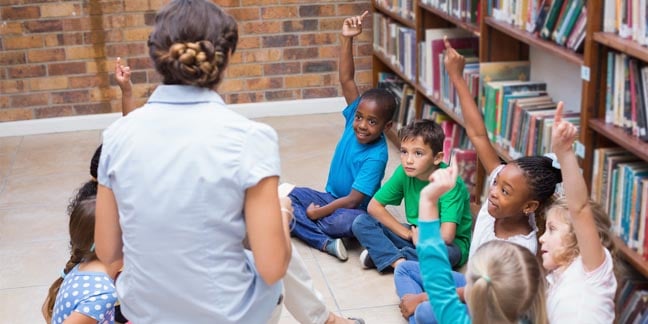
After working with (and for) several early childhood programs, I was hired as an Education Specialist for the New Jersey Department of Education, Office of Preschool. That role took me into preschool programs all across one of the most linguistically diverse states in the country. With a background in the science of language and cognitive development, I visited classrooms with a particular lens and I began to see certain patterns.
What I Saw in Early Childhood Classrooms
Sometimes I’d see a teacher talking at restless children and I’d think, “If he knew more about language development, the children could have a more engaging experience.”
Other times I’d watch someone trying to teach alphabet letters to three-year-olds and think, “If she understood language development, she could start with more effective strategies.”
Most often, I saw children who were new to English struggling to communicate and struggling to understand what was happening around them. I knew there were better approaches in the research.
Those moments were about access to the right information—research-based, practical guidance that could translate into real classroom moves. My knowledge of language development research became especially important as I designed workshops and contributed to state guidance materials on supporting multilingual learners. After nearly every presentation on first- and second-language development, teachers would ask the same thing:
“Do you have more resources?”
Why Early Childhood Educators Need Better Multilingual Resources
I had to be honest. There were plenty of books and articles about multilingual learners in elementary school—but only one book that focused on research with multilingual preschoolers. Teachers, caregivers, and directors were clamoring for a “how-to” kind of guide. Inevitably, someone would say: “Then why don’t you write a book?” So, I met with the Gryphon House editor at the time, Kathy Charner, and I wrote a book. That’s how Many Languages, One Classroom came to be. It was published in 2009, and it opened doors I didn’t even know were there.
I received so many requests to consult and present about the ideas in the book that I was able to move into consulting full-time. I also launched my website: www.languagecastle.com.
That first book didn’t just begin my consulting career—it gave me the freedom to explore all corners of the field for new research, new approaches, and better answers to the questions educators kept asking. Over the years, I collaborated with members of Head Start, the American Library Association, American Speech-Language-Hearing Association, International Teachers of English to Speakers of Other Languages organization, National Association for Bilingual Education, The Pyramid Model, National Early Language Learning Network, researchers, universities and colleges, curriculum companies, organizations, and government agencies… and above all: teachers, caregivers, and assistants.
In every setting, I took notes on the questions people were asking and followed the trail to the best available research and practice. It has been a challenge and a privilege to engage with so many people who work with young children. I have been fortunate to call on resources and ideas from many perspectives.
Why Language Development Matters in Every Learning Experience
This is so important because most early childhood educators have at least one multilingual learner (MLL) in their group—and yet many early childhood resources still don’t address their needs. For example, it’s common to hear advice like “ask open-ended questions.” Teachers ask how they can do that when they don’t speak the child’s language. Many Languages, One Classroom stands alongside so many great early education resources available from Gryphon House with answers to those questions.
I like to keep in mind that language is the foundation of every kind of learning. If you’re a big play advocate—language is at the heart of playful explorations. If you believe preschool is primarily for socialization—language is necessary for communicating with adults and peers. If you love nature exploration or hands-on physical activity—language supports every step of learning. If you are teaching, you are teaching language!
Over time, I realized I had gathered a great deal of new information for early childhood educators working with children who are multilingual learners. I have learned so much from the thousands of educators I have encountered. Along the way, the field has gone through changes, too. We experienced a pandemic shutdown, new state requirements, new versions of NAEYC’s position statements on early childhood education practice, and the appearance of many new and updated curriculum models. I am so glad to have the opportunity to pour all of this into the new edition of Many Languages, One Classroom. I hope this new book helps teachers, carers, assistants, and future educators gain the knowledge, skill, and confidence to support language and literacy development for each and every child.
Karen Nemeth earned her BA in psychology from William Paterson University and her EdM in learning, cognition, and development from Rutgers University. She has been a teacher and a teacher educator for more than 25 years, focusing her expertise on first and second language development in young children. She is a nationally known speaker and consultant and the author of three Gryphon House books. She is also a NAEYC author and consulting editor.
Topics:
Don't forget to share this post:
