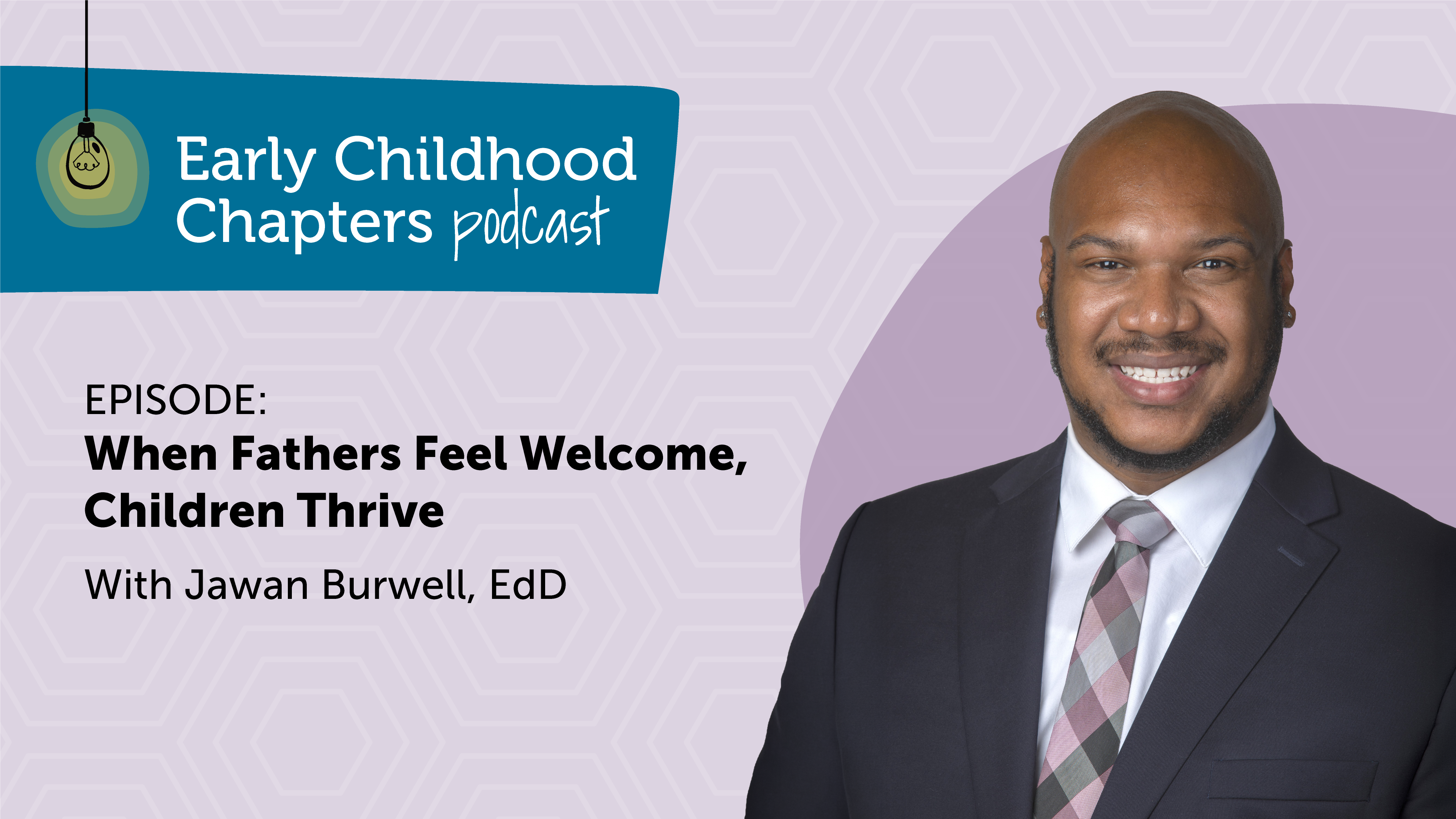
What if the key to stronger family partnerships isn't getting fathers to show up more, but creating environments where they feel genuinely welcomed, valued, and included?
In this episode of Early Childhood Chapters, host Emily Garman sits down with Dr. Jawan Burwell, author of Engaging Fathers: Strategies for Inclusive Family Partnerships in Early Childhood, to discuss why father engagement matters and how early childhood programs can move beyond one-time events to build meaningful, lasting partnerships with fathers and father figures.
Dr. Burwell shares insights from his research and experience as an educator, administrator, and father advocate, exploring the barriers that often prevent fathers from feeling fully included in early childhood settings. Together, Emily and Dr. Burwell discuss practical, no-cost strategies educators can implement immediately, the importance of representation and intentionality, and how schools can better support diverse family structures while creating welcoming environments for all caregivers.
Topics Discussed
- Why fathers are often unintentionally overlooked in family engagement efforts
- Common barriers that prevent father participation
- The impact of engaged fathers on children's academic, social, and emotional development
- The experiences of Black fathers in educational settings
- Why father engagement is about relationships, not events
- Practical ways educators can make fathers feel more welcomed and included
- How broadening our definition of fatherhood creates stronger support systems for children
Whether you're a teacher, administrator, family engagement specialist, or caregiver, this conversation offers valuable insights for building stronger partnerships that help children, families, and communities thrive.
Interview Transcript
What follows is a lightly-edited transcript of the interview.
Why Dr. Jawan Burwell Wrote a Book About Father Engagement
Emily Garman: What led you to write this book? Was there a particular experience or conversation or moment in your own career that made you realize this book needed to exist?
Dr. Jawan Burwell: When people ask me what inspired this book, I always tell them it wasn't one single moment. It was really the accumulation of years of experience. The observations, conversations and relationships that kept leading me back to the same conclusion. Fathers matter, but too often they're overlooked in our family engagement efforts. So throughout my career as an early childhood educator, administrator, instructor, and advocate, I have worked with countless families.
And what I consistently observed was that fathers were showing up for their children a meaningful ways. But many of them were not always designed to engage them as well. They were dropping children off. They were helping with homework, reading bedtime stories, attending events when they could, and supporting their children behind the scenes. And yet, many of the conversations that we had about family engagement were really centered around mothers.
So as a black male in early childhood education, this issue also became a little personal for me because I know what it feels like to be one of those men in those spaces. I understand the importance of visibility, representation and belonging, and that perspective helped me to recognize that many fathers enter into educational settings actually wondering whether they are truly welcome, or whether they are simply tolerated.
So what ultimately inspired me to write this book was listening to fathers themselves. I heard comments like, “no one has ever asked me,” or “I didn't think I was supposed to come,” or “everything always goes through mom.” So those comments really revealed a gap between our intentions and our practice that we do every single day. So I wanted to create a resource that moved beyond simply just telling fathers to become more involved.
Instead, I wanted to help educators, advocates, anyone that works with fathers, with parents, with families, to examine how schools and programs can intentionally create these environments for our fathers so that they feel welcomed and respected and valued as partners in their child's education as well.
Creating Early Childhood Programs Where Fathers Feel Welcome
Emily Garman: Well, as you said, early childhood education is still such a female dominated field. I mean, most teachers in early childhood are female. Moms tend to be the default parent, like you said. So how do we go about creating spaces in early childhood where men, especially fathers, are not just welcomed but genuinely seen as partners and contributors?
I mean, so many school practices, just that I can think of as a parent unintentionally send that message, like you said, that moms are the default.
Dr. Jawan Burwell: Yeah, so I think it starts with recognizing that inclusion doesn’t happen accidentally. Most educators genuinely want their fathers to be involved, but good intentions alone don’t guarantee meaningful engagement. Many of our practices were built around the assumption that mothers would serve as the primary caregiver and nurturer, and always the primary point of contact. These assumptions can also show up in our enrollment forms, in our newsletters, in our classroom communication that we send out, our conferences, and even in our general interactions that we have every day.
When a father attends a conference, and the educator directs every question to the mom, that sends a message to the father. When a newsletter says “moms” instead of families, that sends a message also. So when schools only schedule events during traditional work hours, that also sends a message.
Creating inclusive environments requires intentional reflection, so we have to examine our language, our communication systems, our family engagement strategies, and even our classroom environments.
And we also have to move beyond viewing fathers as occasional volunteers. We have to examine the way that we process and possess unique skills, their talents, their perspectives, because they bring a different approach to the children we work with every single day. So they should also be viewed as contributors, decision makers and partners.
And one thing that I often tell educators is that fathers don’t necessarily need special treatment; what they need is authentic inclusion. They want to know that their voice matters and that their presence is valued just as much as the mom’s is. And when programs become intentional about building these relationships with fathers, the results become very transformative; not only for the fathers, but for the children and families as well.
Common Barriers to Father Engagement in Early Childhood Education
Emily Garman: One of the things I really appreciate about your book is that you don't stop at just saying, well, fathers should be more involved, but you really examine barriers that make that engagement difficult. Kind of on both sides. So what are some of the biggest systemic or cultural barriers that prevent fathers from feeling welcome in early childhood spaces?
Dr. Jawan Burwell: Yeah. So one of the biggest barriers is the assumption that lack of participation equals lack of interest. In reality, engagement is influenced by many factors. Some of the barriers are structural. So as we may know, fathers are working long hours. They have multiple jobs. Sometimes they work overnight shifts or they have limited flexibility. So if engagement opportunities are only offered during the traditional business hours from 8 to 5, many fathers are automatically excluded from this.
Other barriers involve communication. Schools often unintentionally communicate primarily with the mothers, as we already have stated, and they leave the fathers feeling disconnected from some of the important information that they should also be receiving as well. Then you also have those cultural barriers. So society has painted this picture and has reinforced the idea that mothers are the primary care givers and that fathers play the supporting role.
So those beliefs can really influence how educators interact with the families, and they don't even realize it. For fathers of color, particularly black fathers, there can also be barriers related to stereotypes and bias as well. So some fathers may enter educational facilities and settings aware of the negative assumptions that are already existing about their involvement, as well as their parenting or their family structure as well.
So what I emphasize in this book is that father engagement is a shared responsibility. So we have to move beyond asking why fathers aren't participating, and start examining whether our systems are truly designed to support their participation. Because when we shift that conversation from blame to partnership, then we create opportunities for meaningful change.
Men in Early Childhood Education: Representation and Belonging
Emily Garman: Do you think that that bias affects men, black men in particular, going into the field as educators too? I mean, is it is there some kind of bias where a man like yourself who wants to be a teacher feels like, oh, I can't do that, or that's not a field where I would be welcome, even if that's the thing you're passionate about.
Dr. Jawan Burwell: Absolutely, absolutely. And even myself, I can speak from my own experience. When I first started in the field of early childhood and being a director, all eyes were on me. They were like, “oh, why is he here? What is he doing? Men aren't even supposed to be working with children.” And then you have all these different stereotypes that society has painted as well, which is not true.
Especially for me, I'm very passionate about the work that I do every single day, and it's all about making an impact on the children that you work with. And not only the children, but the families that you work with. Anyone that you work with is all about creating that impact and letting them see that you value them and hoping for the success of their child.
So I personally understand how it is when I first started. So yes, it's absolutely biased out there. And that's what really deters men from wanting to join the field or join the workforce of early childhood is because we have those stereotypes and because we have that bias. So we have to shift our narrative to welcome them in. Because like I said before, men bring a different approach to early childhood.
Those partnerships, those relationships that we build. It's a different approach than how women or mothers do it. So that's what we have to shift from that narrative of, males are not supposed to be in the field of railroad childhood because representation absolutely matters as well.
How Father Engagement Benefits Children's Learning and Development
Emily Garman: And the research is really clear. There's plenty of research that talks about how the engagement of men and fathers benefits children socially, emotionally, and academically. So from your perspective, what changes do educators start to see in their students, in their children when fathers are more actively involved?
Dr. Jawan Burwell: Absolutely. The impact can be incredibly powerful. Of course, we know the research consistently demonstrates there's always positive outcomes associated with father engagement, but I've also witnessed those firsthand throughout my career since I began. When fathers become actively involved, I've noticed that the confidence of children begin to increase. They have stronger self-esteem. They have improved emotional regulation as well.
They also gain a sense of security when they see the important adults in their lives working together. Academically, they begin to demonstrate greater motivation, persistence. They begin to see education as something that matters because multiple adults are reinforcing this at the same time, socially, we begin to see those skills begin to develop and increase as well them interacting with peers and adults.
One thing I can particularly say is it benefits all children, not just boys. So when we think about fathers, the narrative has been painted in society that they are the disciplinarians. Well, it also goes back hand in hand with our boys as well. So it's not just boys, it’s girls as well. We want to ensure that they benefit from all of it.
They benefit tremendously as well. And perhaps most importantly, finally, engagement, sends this powerful message to children that you matter and that you value and that your education is very important, and these are the people that are invested in your success as well. So that's the message that every child deserves to hear.
Emily Garman: And if children of both genders don't see men in roles as teachers, or they don't see fathers being involved, then that just perpetuates that stereotype. Then they learn, oh, okay, well, when I grow up and I'm a dad, I'm not really supposed to be involved with my kids. I mean, so we have to break that cycle.
Moving Beyond Events: Building Meaningful Relationships with Fathers
You include a lot of real world examples and success stories from programs that are finding creative ways to engage fathers. I'd love to know, is there is there a story in particular that especially stayed with you, or really stuck out or surprised you when you were writing the book?
Dr. Jawan Burwell: Yeah, absolutely. It's hard to choose just one. But one of the biggest lessons that I learned while researching and writing this book was that successful father engagement isn't necessarily about creating more events, it's often about creating more relationships. So I came across several programs that shifted from asking, how do we get fathers to attend to now? Asking, how do we build stronger relationships with our fathers?
So that change in mindset completely transformed their approach. So one program in particular that I do remember that I wrote about, they invited fathers to share their hobbies, their careers, their cultural traditions and life experiences with the children. And rather than asking the fathers to simply attend the event, they invited them to contribute something meaningful. So participation increased dramatically because the fathers felt valued rather than being recruited in.
And what surprised me the most was how simple many of the successful strategies were. So they didn't require large budgets, complicated programs, they just required being intentional. And that's what we have to do with our fathers is be intentional, and we have to build these relationships with them as well, with the genuine belief that they have something valuable to offer to us as well. And that was very encouraging, because it means every program can make progress regardless of size or resources, and that fathers truly matter in the success of their children.
Black Fathers, Bias, and Family Engagement
Emily Garman: So we've talked about this just a little bit, but I want to kind of open it up more to talk about race, specifically with father engagement, because your book does not avoid that conversation. And it's absolutely a factor and part of it.
In your experience, in your research, are the experiences of black fathers, specifically in school settings different from those of white fathers? And if so, because I imagine they are; what do we need to better understand about that reality? And it isn't just saying that it's not happening, or ignoring it.
Dr. Jawan Burwell: Yes, I believe the experiences can absolutely be different. It's important that we're willing to have these honest conversations as well, because it does happen. Many black fathers are deeply involved in their children's lives, but the societal narratives often tell a different story. We have those stereotypes about black fatherhood continuing to exist despite the evidence that contradicts those assumptions.
So as a result, some black fathers enter into educational spaces carrying the weight of those stereotypes that are out there. And so they may wonder how they will be perceived before they can even walk through the door. So educators need to understand that engagement isn't happening in a vacuum. So historical experiences, societal narratives, and personal interactions, they all shape how families engage with schools.
And one of the most powerful things that educators can do to build these authentic relationships is get to know fathers as individuals, rather than just making assumptions about them based on the stereotypes that they have heard. And so when fathers feel respected, when they feel trusted, when they feel valued, this is when the meaningful partnerships start happening.
So the goal isn't to make educators feel guilty at all. That's not what we're trying to do. But the goal is really just to increase awareness that schools become places where every father feels welcome. Not white, not Asian. Every father should feel welcome and respected when they're working in these spaces.
Emily Garman: It strikes me; I talked to a lot of authors and a lot of people who work in education and something that I see consistently happening, is that bias, stereotypes and assumptions always hurt people, whether that's making assumptions about students with autism or black boys or black fathers or fathers in general, or men in education, like the stereotypes that we hold always harm people, so the more we can unpack that and expose it to the light and start talking about it and getting past it, then everyone really benefits.
Expanding Our Definition of Fatherhood and Father Figures
Emily Garman: we talked a bit about events earlier, and I know most schools probably have things like “donuts with dad” or muffins with mom, and you talk about that father engagement is beyond just these events. Because I mean, please, as a parent, we don't need any more events! And I imagine teachers feel that way too. But so I really appreciate that your book acknowledges different family structures and definitions of fatherhood.
So yes, we want to have an event where fathers are welcome, but it doesn't have to be at the exclusion of something else. So how important is it for educators to broaden their understanding of who counts as a father figure in, or your significant male caregiver in a child's life?
Dr. Jawan Burwell: It's incredibly important, because families are diverse and our engagement efforts need to reflect that reality. Not every child lives with their biological father. Some children are being raised by grandfathers, by uncles, by stepfathers, by their older siblings, their brothers, foster parents, coaches, mentors. I mean, the list can go on, but we just have to realize that this is the reality now. When schools start to define father engagement too narrowly, that is when the exclusion of fathers begins to happen.
So the focus should be less on biological relationships and more so on meaningful relationships. An example that we do at our school is we used to have a father field day, and it was strictly for the fathers. The moms couldn't come, the aunts, the sisters. It was strictly for the males because we wanted to bring that representation, to let them know, let the children know that their fathers matter. Now, there were some that did not have their biological father there, but they did have an uncle. They had a coach. They had a mentor. They had me. I mean, anyone could step in. And, you know, when they see these men engaging, they engage in a different way. You should see the smiles on their faces when they engage with their, you know, their dads or that father figure.
It's like, oh my gosh, my dad is here. My uncle is here. I'm so excited. And just to see the joy on their face just says a lot. So, you know, we have to, you know, again, shift our mindset on those biological relationships and know that these are individuals that we should be engaging in our programs. And at the end of the day, children benefit when caring adults work together.
So, I mean, although it be dad can't come, let me see if I can get Cousin Jeff to come. I mean, just building that relationship is what really, really matters. So broadening our understanding of fatherhood really allows us to create more of an inclusive and supportive environment for children and families.
Practical Strategies for Engaging Fathers in Early Childhood Programs
Emily Garman: There's a really strong, practical thread running through your book. So tell us about a few simple changes that an educator, a teacher, a principal, a center director could make right away tomorrow, not costing any money that would immediately help fathers feel more included and valued.
Dr. Jawan Burwell: One of the easiest places to start is communication. So look at your enrollment forms, look at your newsletters, your emails, websites, social media posts and really ask yourself whether fathers are explicitly included in your messaging that you're sending out. Another simple strategy is relationship building. So learn father's names, greet them at drop off and pickup. Ask them about their interest in their experiences as well, and include them in these conversations about their child's success. Because again, we are shifting the mindset and shifting the narrative of fathers just being the disciplinarian. So most times when we're talking to fathers or when individuals are talking to fathers, they just want to let them know that their child was not listening for the day, just the concerns. So we want to shift from that. We want to tell them about the child's success.
And then, of course, representation matters as well. So we have to look at our books in our classroom, our bulletin boards, the pictures that we have posted around the classroom, in the displays. You have to ask yourself, do fathers and male caregivers see themselves reflected? Also I encourage programs, I encourage them all the time, to move beyond event-based engagement.
So father engagement shouldn't be just when we have special events or special occasions, or if we're going on a field trip or anything like that, it should be embedded into the daily culture of the program. So most importantly, ask fathers what they need, they want to be engaged. Too often when you create engagement opportunities without consulting with the very people that we're trying to engage.
So that goes back to being very intentional about what we're doing, because if they're not interested, they are not going to show up. So get their feedback, see what they want to do, actually have them initiate it, facilitate it. They really enjoy doing things like that. And you won't even imagine how that would make them feel. When fathers feel heard, when they feel respected and valued, I mean, the engagement begins to flourish.
Father Engagement Is a Mindset, Not a Program
Emily Garman: So what do you hope that readers walk away with after finishing your book? Engaging fathers, if they remember just one core message from the book. What do you want that to be?
Dr. Jawan Burwell: If readers remember only one thing, I hope it is that father engagement is not a program, it is not an event or a checklist. It's a mindset. It's about recognizing that fathers and father figures are valuable partners in children's lives, and that intentionality, really creating opportunities for meaningful engagement is really important. I hope educators walk away with the understanding that fathers don't need to be fixed.
They also don't need to be convinced, and they don't need to be rescued. Many fathers are already engaging in ways that may not be visible to us, so our responsibility is to recognize these strengths and build upon them. I also want readers to feel empowered as well, knowing that you don't need a large budget or a major initiative to improve father engagement, because often the most meaningful change begins with listening.
That communication that we talked about, the relationship building and just being intentional. I can say intentional all day. You have to be intentional about the fathers that you are working with. The most important message that I want readers to remember is that when fathers feel seen, when they feel welcomed, when they feel respected and valued, children benefit from this. And when children benefit, families grow stronger. And then when the families grow stronger, schools grow stronger. And then when the school grows stronger, the communities grow stronger as well. So that's really what this book is about. It's not just about engaging fathers. It's about creating partnerships that help children thrive.
Emily Garman: Dr. Burwell, thank you so much for joining us today and sharing your expertise, insights, and passion for strengthening family partnerships in early childhood education.
This conversation highlights an important truth when fathers are intentionally welcomed and engaged, children, families, and school communities all benefit. If you'd like to learn more, be sure to pick up a copy of Dr. Burwell’s new book, Engaging Fathers: Strategies for Inclusive Family Partnerships in Early Childhood. You can also find additional resources on family engagement, equity, and building strong school/family partnerships at Gryphon House.
Thanks again, Dr. Burwell.
Dr. Jawan Burwell: Thank you so much. It's been a pleasure.
Emily Garman: Thank you for listening to Early Childhood Chapters. We'll see you next time.