Episode Transcript
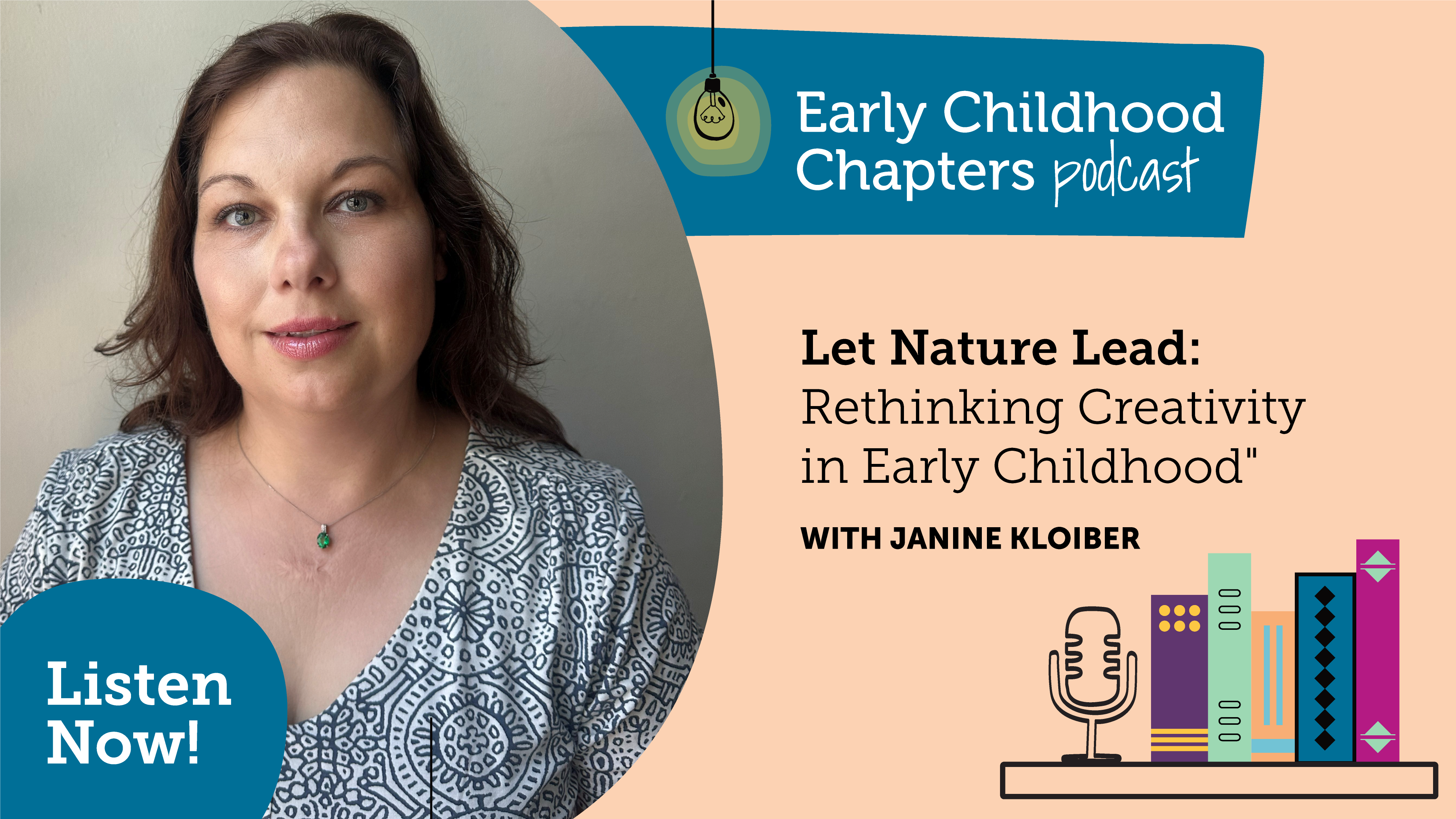
Emily Garman: Before children ever pick up a paintbrush, nature has already given them a palette. Sticks, stones, leaves, soil. Petals. Bark. Today we're talking about how the natural world can become one of the most powerful creative tools in early childhood classrooms. My guest is Janine Kloiber, author of the beautiful new book from Gryphon House, Nature's Palette. In this conversation, we explore how natural materials can spark creativity, deepen children's sensory experiences, and help young learners build a meaningful relationship with the natural world.
Janine is here to talk about her new book, and share some practical ways educators and families can invite children to slow down, observe, and create with the materials nature provides. Let's jump right into the conversation. Janine, thanks for being with us here on the podcast today.
Janine Kloiber: Thank you so much for having me. I'm so excited.
Emily Garman: Well, I want to point out that you are joining us all the way from Germany today. So I don't know what time it is there, but thank you for taking the time.
Janine Kloiber: It's 8 p.m. right now, so.
Emily Garman: Okay, well that’s all right.
Janine Kloiber: It’s almost bedtime.
Emily Garman: Okay, well, we won't keep you up too long, so I will say this is one of my favorite books that we’ve published at Gryphon House, because it's just so beautiful. The full color illustrations and all the photographs that you've taken of the work that you've done and clearly have enjoyed doing. I just love nature topics and nature art. So let's get right into just what what inspired you to write this book?
Janine Kloiber: Well, you know, I love nature. I'm outside all the time. Even if it's rainy and stormy. You will find me at the shore, being pushed around by the forces of nature. I really like it. And I notice that nature has such a powerful impact on me. It slows me down. It clears my head. And if I have a bad day, you know, I just go around the block.
But I also notice that it has the same impact on children. Like if my children at home or at work have a rough day, things get much better when they are outside and I love giving them the chance whenever they can, whenever I can. But unfortunately, we all know that childhoods have changed and our kids are more inside.
They are in front of the screen all the time, and so they are losing their connection with the natural world. And we notice that at work, because children don't know how to interact, act, or how to engage with nature when we take them outside. Often times we see children not sure what to do. They don't have the urge to discover anymore.
They don't notice what's just around them. And also if there are no structured activities, they really don't know what to do. And this book can give us a chance, or give us more reasons for children to go outside and to inspire them and encourage them to just go outside and explore with them.
Emily Garman: Now, you're a classroom teacher. What ages do you teach?
Janine Kloiber: Well, that has changed over the years, but mainly it's 3 to 6 years old.
Emily Garman: That's such a perfect age for getting outside. Everything is new to be discovered!
Janine Kloiber: Yeah. And it's always a big adventure when you point out look at this, look at a little earthworm. All of a sudden they are completely engaged for an hour. You know, they don't need anything else.
Emily Garman: They don't. They really don't. You don't have to give them toys. So I know you are in a Montessori setting, or you have been in a Montessori school setting, so for our listeners who don't have a Montessori background, how does the Montessori philosophy kind of connect really well with nature based learning?
Janine Kloiber: The nature-based learning approach is actually deeply connected to the Montessori approach, because both of them see the child as an active explorer who learns through hands-on experience and the real world, and the natural approach in the natural world. So they both encourage to let the kids actually do the discoveries and give them chances to explore.
Emily Garman: I know my own child attended a Montessori school, and one of the things we heard a lot was “follow the child.” And that doesn't mean just let the child do whatever they want to do. But what does that really look like outside?
Janine Kloiber: And thank you for pointing that out. I cannot tell you how many times people approach me and they tell me, “oh, you work in a Montessori school, follow the child. That means the kids can do whatever they want, right?” Oh no, that's far from true. That's not true at all. Yeah. Follow the child means, as you know, that we deeply observe children and we follow their lead. We give them freedom within limits. They can choose what they want to do, what kind of activities. But there are certain rules they have to respect. And when we are going outside, well, how should I describe…
For example, I plan to take my children outside to the park and we want to study trees. It's fall, the leaves have changed. So that's on my agenda as a teacher. We take them to the park. On the way to the park, all of a sudden the kids are completely fascinated with ants. There might be a road of ants passing by. There might be just one ant. And in the Montessori setting, I will put my tree lesson on pause. I will become a co-explorer. I'm not a teacher anymore. I'm not the instructor anymore. I'm exploring with a caravan, and we will stop whatever I have planned. And that's not always easy for me, I admit, you know, but we get to see what we can discover. We will just observe what the ants are doing. We will see where they are coming from, where they are going. We are asking open ended questions. So kids might ask me questions I cannot answer. And that's okay too. We will go back to the classroom later and look it up. But yeah, follow the child outdoors means also that I become a co explorer and not just an instructor.
Emily Garman: One thing I really liked about the Montessori approach, too, is at least at my child's school, the teachers were called "guides" instead of teachers, or you know, they were they were guides, which I liked that they're guiding the child rather than just transferring knowledge to them. And that idea of being a co explorer is really nice.
Janine Kloiber: And I see it like this. I'm equally fascinated, you know, when we see mushrooms--I love mushrooms, we take pictures, we draw them. We had a whole album of mushrooms. My kids at school would print pictures of them. When they go for a walk and they find a fascinating mushroom and they look it up, I'm equally excited. And I'm very glad that I can explore with my children.
Emily Garman: I think that would be part of keeping, joy in your profession, too, if you are exploring with the children and you learning new things, and you just never quite know what the day holds, that that keeps your job interesting and exciting and fresh, too. And it's I know teachers get burned out sometimes, but that that would help.
Janine Kloiber: It definitely helps. You know, it. It just makes it so much more exciting.
Emily Garman: Now. Not everybody listening to this episode or reading your book is obviously going to be in a Montessori setting. So do you have to be in a Montessori school to think about an approach to nature education in this way?
Janine Kloiber: No, no. As a matter of fact, I became a Montessori parent before I became a Montessori educator. I read a lot about Montessori when I became pregnant, and I just loved the philosophy. And so we raised our children that way, and it gave me one more reason to actually become a Montessori educator. And you don't have to be a Montessori teacher.
You should just follow the principles of letting the children explore. Giving them freedom within limits and follow their lead, observe what they are really interested in, and then help them to discover what they would like to discover.
Emily Garman: I remember in my child's Montessori classroom, everything was real. So they didn't use a pretend toy plastic hammer. They would use a real hammer or a real screwdriver. So in this book, you really emphasize using real materials and real tools. And why is that so important, even for very, very young children?
Janine Kloiber: Maria Montessori strongly believed that allowing children to interact with the real world allows them to have real, meaningful experiences. Like if a child, for example, would cut fruit that could be eaten later on. It made a difference in the daily schedule, in the daily life. And if a child would sew a hand warmer that could be used.
So as the children are learning, whatever they are doing has an impact in the real world. And it's just not pretend. Like in a Montessori classroom, as you said, there is no play kitchen, but we cook and bake with them all the time.
One of my favorite examples is like 2020. There was this big wildfire in Australia. So I took my students and we were sowing some bat wraps they are called, little pillows with blankets. Actually, I have one here. And you would put the baby bat on there and then you would wrap it around it. And so we were sewing, I think, around 30 of them and shipping them to Australia, and children as young as three years old helped sewing with a few stitches. They filled the material. And they were filled with such a pride to know that their work actually helped, that the little baby bat, you know, is comforted. And I don't think they would have had the same experience if they would have just pretended to sew something.
Emily Garman: I think that is such a great example of showing the respect and engagement that comes from using real materials and that children receive from being trusted with real materials, too. We're saying we are trusting you and respecting you as a child to engage with real things and real tools. So that level of respect and engagement; I wonder how that translates to having more of a respect for the natural world and caring for our environment. They spend a lot of time outside in the park. They might be more conscious about picking up litter in the park because they care about the space. They're engaged with it in a different way.
Janine Kloiber: Yes, you're right. And I think also because they are interacting with nature in a different way, they are naturally becoming more respectful because they see nature now as something valuable, as something interesting, rather than something that's laying on the ground that can be kicked around. And once they slow down and start to observe, they start to notice that there's so much more around them.
If you look at a pile of dirt, it's just a pile of dirt. But if you slow down, if you kneel down, if you look down there, there's so much life in there. And I think hardly any of our children would ever kick a pile of dirt because there are ants inside, or caterpillars or whatever. So you just become more in sync with the nature and they automatically become more respectful because they know that they are part of an environment that needs to be protected.
Emily Garman: Your book repeatedly emphasizes sensory exploration. So just slowing down and noticing tiny things in the world around us, and in this world that feels so increasingly fast paced, what happens when we invite children to just slow down and observe nature?
Janine Kloiber: When we invite children to slow down, they will be able to notice so many beautiful things around them they would not have noticed before. And when we give them the chance to discover and explore without any rush and without being distracted, you will see that there will be a tremendous increase in focus, interest and concentration, because they are completely absorbed in what they are doing in the here and now, and you will see that there is a lot of creativity that will flourish, because when you see them discover or slowing down and observing, all of a sudden they will get great ideas.
“Oh, look at them, look at the ants! They are building like a whole road here. How about if we build them a little bridge so that they can go over this little river?” That's something you don't see when you are just walking past something and rushing them from one place to another, and you will see an increased respect for what is around them, because they actually start to notice that there are ants on the floor, on the ground, and that they are living things all around us.
Emily Garman: So one thing that that this brings to mind too, as a parent with a child who's been through school, parents I think are used to getting things sent home, like your child made this art project today and they bring it home and you put it on the on the wall. But with these kinds of open-ended activities, you may end up spending the entire class period focused on a pile of dirt or an anthill, because that's what the children are really interested in.
So with with these open ended activities and really process-oriented art, they're not producing a product. Can you talk a little bit about this kind of process art and the process of creating versus take home product, delivery based art?
Janine Kloiber: Oh, Mary Ann (Kohl, another Gryphon House author) would love to be part of this conversation!
Emily Garman: I was just thinking about her, too. Yes. This is totally her wheelhouse.
Janine Kloiber: Well, when we talk about process versus product, it's really about, well, if you talk about a product, if I want to make something with children, there's always a certain outcome I'm expecting. So there is like, for example, a bird collage, and there’s a certain way of making that collage. So children are following step by step all the directions, and all the birds look very similar.
And don't get me wrong, these kinds of activities have their place in the classroom. There are sometimes times when they're good, but when you are using, open ended activities, yes, there is no outcome. I cannot tell you what the children will actually come up with. I will provide materials like sticks, stones, glue, paper, but it's really up to the children if they want to make a collage, if they want to start stamping, if they want to use some thread and wrap it around a stone, that is really up to them.
For example, in a few weeks we have Mother's Day and yeah, and in some schools you will get a beautiful picture frame and a beautiful picture and a paper pieced flower, and that gets sent home. And the child has done the cutting, but 90% of the work has been done by the teacher, which, you know, it's a lot of work for us teachers! But it also doesn't involve the children.
Well, we we give out flower pots, and the kids can do whatever they want with them. They can put moss on it. They can wrap some strings around, whatever they want. And it might be that a child says, I don't want to do anything with that, you know. And that is fine too, because he might just find a beautiful rock and he will give his mom a beautiful rock instead of, you know, a painted flower pot.
But then also, we invite the children to decide what they want to put in the flower pot. And then we go outside and we look at the gardens, we have some herbs, some flowers, and we take some of that and we put it in. So yeah, you don't know that outcome, and it's sometimes very hard for us as educators to step back because we are so used to judging the success of a product or a project by seeing if it's perfect or if it's fulfilling a certain standard. And with process art, this will never happen, you know?
Emily Garman: Well, we don't compare it to others, we don't say like, oh, well, that child drew inside the lines better than this one. Or my child didn't line up their flowers quite as well as that child. I mean, there's no comparison needed because they've just made something unique.
Janine Kloiber: Correct. And it gives them also the freedom. And it allows them to take more risks. Because if a child has to make a product, and they know there are certain things expected, they would do what is expected because they don't want to have any problems. They don't want to have to redo the project again. But if you let them go, a child might say, oh, you know what? How about I stamp on the flower pot, and then I use some yarn and I wrap it around it, and then I build a pedestal with a rock, and it might not work because some rock might be too uneven. And that is okay. You know? But they know it's okay to make mistakes. We learn from mistakes. I mean, I wouldn't even call it mistakes. Learning opportunities. So instead of saying, oh, it didn't work, we say, oh, we just change it up and we do it a different way.
Emily Garman: And they learn that there's not just one right way to do this project. We're not all just making this the same way. And by doing things differently, they come up with new ways to do things. I think that that's one of the most beautiful things about watching kids do art.
Janine Kloiber: I love this too, and I'm always excited to discover what they are doing. They inspire me too. You know, some of the project in my book have been inspired by my daughter. She would say, oh, why don’t you do this? There are some chestnut birds. And she said, mom, I have an idea. And I made those chestnut birds and I love them so much.
Emily Garman: Well in terms of of getting students, getting children outside to be, I mean, we can all bring in natural materials to a certain extent, but not every school or environment is going to be in a pretty natural environment. We don't all have lakes and streams and forests nearby. So, your book talks about alternatives to that for programs that don't have easy access to good outdoor spaces, how can they still do this kind of work?
That's actually easier than you think sometimes. You know, I talk to a lot of educators and they will say, oh, you know what? We don't live at the shore. We don't. We are just in the middle of the city. And I get it. But you don't need a lot of space. The key is to bring natural materials inside and to allow the children to engage with that in a relaxed atmosphere.
For example, you can offer a sensory bin with some rocks or some pine cones or some sand and some water in it. Or you can bring in some plants. You can have some herbs in a little container to raise salad. You just need a little bowl, a salad bowl, to start, you can raise actually salads there.
One of my favorite activities actually is around Halloween. We would always bring inside a pie pumpkin. And we would cut it open and the kids would explore it with all of their senses. We would touch the flesh. And if they don't like it, we would put it in a Ziploc bag and then they can just touch it this way.
We would look at the skin and then we would take this little pumpkin and put it in a plastic jar, a ginormous jar, and we seal it up, and then this pumpkin goes on our windowsill, and then we will watch how the pumpkin will actually decompose. Over the following weeks, you will see how this beautiful orange pumpkin becomes actually a moldy mess.
And so we bring the compost inside. And in spring we would bring the pumpkin or whatever's left, outside, we would open the container, put some soil on it, and we would water it. And then the children can observe how actually new pumpkin plants would come out. And I love this project. And you don't need a garden for that. Even if you don't plant this pumpkin plant afterwards, you can hand it to someone who might have a garden, or you might try indoors, just put it in a bucket and put a grow light on top of it. you don't need a lot of space for that.
I also have in my classroom always a shelf where children can bring nature treasures, whatever they find on walks or in their yard, and there's usually a whole shelf full of rocks, shells, pine cones, you name it. Sometimes even you know, butterflies in little containers. So that's because that is part of nature too. There might be dead animals, but I always encourage them to bring them to school and that so that we can discover them.
And on the shelves there would usually be some magnifying glasses, some microscopes and some books to look up what we have placed on the shelves. So I strongly believe you can bring nature in any classroom. You just need to ask the children to bring some stuff, maybe from home.
Emily Garman: And when they get the chance to bring something and talk about it, share about it with their friends, with the class, it's such a rich opportunity for language and discussion and asking questions and learning to listen to others. And those are all skills that lead to literacy. You know the pre-literacy skills. Just listening and talking and hearing words.
Janine Kloiber: Of course, and allow them to be encouraged to talk, and to feel proud of what they have found and talk about it. Yeah. It's a huge, positive chance for them to develop literacy skills. Definitely.
Emily Garman: We talk a lot about social emotional learning. And in the book you write about helping children build self-esteem and express themselves positively. And, I wonder what changes do we see in children, versus a very traditional classroom, when they're given freedom to create open-endedly with natural materials? Do you see increased confidence in these children and more collaboration?
Janine Kloiber: Yes. Of course. Yes, definitely. Because they don't have the pressure of producing something perfect and they don't have the pressure of fitting in. They can be just here and in the here and now. They are able to take risks and therefore they are also often more open to work with other kids together. When we go outside and let them do open ended activities with nature materials, you see that they automatically become calmer because they don't feel rushed. They don't feel sensorily overstimulated. And they are in the here and now.
And as I mentioned before, their attention tends to be longer and they will actually engage with other kid kids in a more meaningful way because they might actually see, oh, wow, they built a bridge that looks completely amazing. And then they will go there and they will ask, you know, if they could help. Or another child might find an interesting insect. They will go there and explore with the other children together, and they are more open to take risks together and to troubleshoot together because they know that there's no right, no wrong.
Emily Garman: they can't fail. They're not afraid of failure. Just learning in exploration. I mean, the idea of failing it being a negative thing. I mean, that's something that we're teaching kids somehow, inadvertently, and so this is working to undo that.
Janine Kloiber: And it's even in the Montessori classroom when we work with real materials like a glass picture and they spill water, no big deal. You know, it's not a mistake. It's just something that needs to be cleaned up. And then there's always a sponge nearby. If something breaks, that can happen. We just need to clean it up. You know, by taking away the stress of not making a mistake, you will see a big change in the behavior of children.
Emily Garman: And I know a big part of that with the Montessori approach is getting parents on board with this idea and, letting them practice those things at home, too, using real glass cups without lids, things like that. So you talk about in the book allowing children to bring these treasures home and involving the families more. So, what are some ways that this book is really applicable to families, to not just classrooms? How can families extend these activities at home?
Janine Kloiber: Well, I think not only children need to slow down. I think we as parents need to start to slow down to. Yes. And when I talked in the beginning about putting the screens away, I think we as parents need to do this too. Sometimes you see kids in the park and the parents are nearby but their eye is on the screen.
So I think we as parents need to remind ourselves to, to be in the here now, to slow down and to observe. And by asking the parents to get involved, by helping to collect nature's treasures,
we are inviting them to become co explorers, too, to join their kids on this discovery and to maybe notice things they would have never noticed before.
I do we do this all the time in our school. We asked, hey, can you guys bring something for the sensory bin that should be fall-themed like pinecones and acorns, and you will be surprised how many bags of acorns and chestnuts we would get. And not only the children were proud, but the parents too! They would say, you will not believe what we found and they tell us all about these beautiful weekends they had discovering these things. And it starts a conversation between the parents and children that leads into so much more, because there comes now, an invitation for them for other weekends. They don't have to do this just for school, but they might do this also for home as well.
And parents might notice when they become co-explorers, they might notice that they see their kids also in a different way, because kids can see the most amazing things when we explore together, they have hypotheses you would not believe! And it's beautiful to listen to them and to find out what they see when they slow down and look down.
Emily Garman: I think that's one of the most rewarding things about being a parent and working with children is that you get to see the world a second time, discover everything through their eyes. They will think of things, because they haven't learned all of the rules that we have as adults, and they'll think of things that we had forgotten. It’s neat.
Janine Kloiber: I know, and it's beautiful to listen to them and to see the world through their eyes and sometimes and I think we as parents too, sometimes believe that we have to be instructors. Everything has to have a purpose. And we want to do only the best for our children. I think we can do so much by just slowing down and observing with them and discovering with them.
Emily Garman: And being able to say, well, I don't know, let's look that up together. Let's find out. We don't have to know all the answers.
Janine Kloiber: No, for sure not. I mean, I learned so much about ants last year. I had no idea. That became all of a sudden a big topic, we didn’t know. The year before it was water pigs (Capybaras). I didn't think I would learn about them, but my students at school were completely fascinated with them, and I love to go on this journey with them.
Emily Garman: So if there's if there's one thing from the book that you could recommend that you wish every teacher could do right now, what would it be?
Janine Kloiber: Allow yourself a day where you'll pause your curriculum and listen to your students, and find out what they are really interested in, and slow down and become a co-explorer with them. And I know it's not always easy. As an educator, you have certain lesson plans that you have to fulfill. They have so many students, there are so many meetings, but just listen to them what they are interested in and let them guide you a little bit. That would be my biggest hope, because I think also when children are excited about something, they are able to learn so much more because they are there with their whole heart.
Emily Garman: Absolutely. Thank you so much, Janine. This has been a really fascinating and inspiring interview. I've I've enjoyed our time together. I would I wish I could come to Germany and see your classroom.
Janine Kloiber: Come on over. It’s not a problem.
Emily Garman: Thank you very much. Well, thank you for joining us for this episode of Early Childhood Chapters. I hope this conversation with Janine Kleiber has inspired you to look at the natural world around your classroom or home a little differently, and maybe even gather a few new materials for creative exploration. If you'd like to learn more, you can find Nature's Palette from Gryphon House books, wherever professional books for early childhood educators are sold, and at our website, Gryphonhouse.com. And if you enjoyed this episode, be sure to subscribe to the podcast and share it with a colleague or friend who loves helping children learn through creativity and nature. Thanks for listening and we'll see you next time on Early Childhood Chapters.