The “science of reading” has become one of the biggest conversations in education—but what does it actually mean in early childhood classrooms?
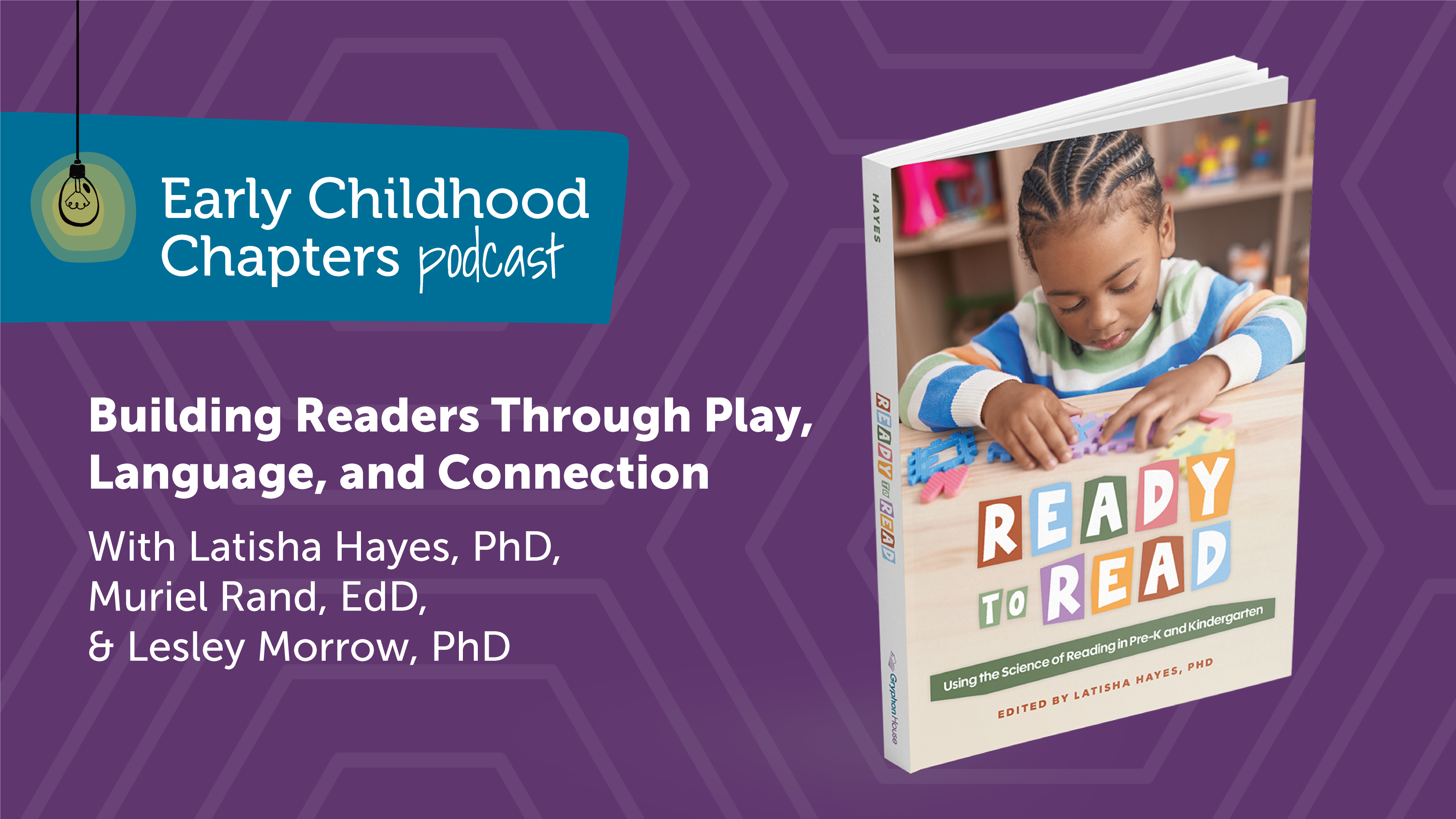
In this episode of Early Childhood Chapters, host Emily Garman is joined by Dr. LaTisha Hayes, editor of Ready to Read: Using the Science of Reading in Pre-K and Kindergarten, along with contributors Muriel Rand and Dr. Lesley Morrow, for a thoughtful conversation about how young children truly develop literacy.
Together, they explore why early literacy is about much more than memorizing letters or sounding out words. From oral language and background knowledge to storytelling, dramatic play, and meaningful interaction, this episode unpacks how children build the foundations for reading long before they can read independently.
The conversation also tackles:
- What the “science of reading” really means in early childhood
- Why play is essential—not separate from literacy learning
- How oral language and vocabulary shape future reading success
- The teacher’s role during play-based learning
- Ways to create literacy-rich classrooms without expensive materials
- Why motivation, curiosity, and joyful learning matter
Whether you’re a preschool teacher, administrator, caregiver, or parent, this episode offers practical, research-based insight into supporting young readers in developmentally appropriate ways.
Book featured:
Ready to Read: Using the Science of Reading in Pre-K and Kindergarten
Episode Transcript
The following is a lightly edited transcript of our interview.
Emily Garman: What if getting early literacy right isn't about choosing between play and instruction, but understanding how they actually work together? Because long before children can decode words, they're building the real foundation for reading through language, knowledge, and meaningful experiences. So what does the science of reading really look like in the classroom?
Welcome to Early Childhood Chapters, a podcast from Gryphon House books.
I'm your host, Emily Garman, and today we're taking on one of the biggest topics in education right now: the science of reading. But what does that actually mean for our youngest learners?
I'm joined by Dr. Latisha Hayes, editor of Ready to Read, along with contributors Muriel Rand and Dr. Lesley Morrow. Together, they'll help us unpack how early literacy development is built through intentional instruction, rich language experiences, and, yes, play.
Well. Welcome to all of you, and thank you so much for making the time and the technological effort to be here. I really appreciate it. We're so excited. So, Tisha, to start us off, there's been so much conversation around the science of reading. Tell us, what does this term actually mean in the context of early childhood. And what do you most want educators to understand about it? So to be clear, we're not talking about explicitly teaching preschoolers how to read, right?
Dr. Latisha Hayes: Emily, I want to start off by saying that the science of reading doesn't mean that we need to abandon what we know about developmentally appropriate practice. In fact, I think it reinforces that work. As early childhood educators, we want to deepen our understanding about how children learn to read and write so that we can do our best job.
And I think that's exactly what the science of reading offers us: a deeper understanding, a clearer purpose, and a stronger alignment between what we teach and how children learn. And some ways I think about it like this. The science of reading is our instructional backbone. So when I use the term science of reading, I'm not talking about a specific instructional approach, a certain program, or a mandate.
I'm talking about a large body of interdisciplinary research that helps us understand how language and literacy develop over time, and instructional practices that support that development. It helps us see what matters first, what comes next, and how early experiences set the stage for later reading success.
And so, no, we aren't talking about explicitly teaching preschoolers to read per se. What we are talking about is intentionally building the foundations that lead to greater reading and writing outcomes for kids.
Emily Garman: This book, Ready to Read, brings together many contributors that you have pulled together, different areas of expertise. So when you were organizing the book, what was your vision and how did you decide who needed to be included and what educators most need to hear right now?
Dr. Latisha Hayes: Well, like you said, we're talking a lot about the science of reading right now. And, for me personally, I saw this need for an accessible resource in early childhood. And so that's sort of how the book came to be. And when I was conceptualizing it, I was thinking about really myself and that I sort of function as a teacher with a North Star.
So my North Star, it's just a set of core research-based beliefs to guide our work in classrooms every day. That leads to our intentional instructional decisions so that I don't become instructionally adrift. In some ways, in the book, we talk about it like this. Is that your core set of beliefs or your North Star? It's your navigation system.
And so the book is organized with this in mind, and I decided to lean into a commonly used framework that has been well established in research. The simple view of reading and the simple view considers our ultimate goal, which is reading comprehension. And it shows us that reading comprehension is a product of word reading and language comprehension.
So knowing successful reading comprehension is our goal. It's our end game. The book unpacks the skills young children need to develop that lead to word reading and help build language comprehension. And so this really led to the architecture of the book. Parts two and three are devoted to these skills. In part two, the chapters outline topics that help build language comprehension like oral language and listening comprehension, vocabulary and background knowledge.
Part three brings together the skills that lead to word reading like phonological awareness, alphabet knowledge, and early phonics, as well as early decoding, spelling, and writing. And I pulled these topics apart for the chapters in the book for conceptual clarity, but not to imply that these components exist alone or function in isolation. And so the introduction to each of these parts is really used to demonstrate how these things work together.
And so I've talked about parts two and three, but I never talked about part one. And part one lays out the North Star starting with the simple view. It also weaves in overlapping, intersecting practices that have been found to be highly effective in early childhood classrooms. And each chapter pulls in these core practices. One essential core practice is play, and that is one of the chapters in the first part, sort of laying the groundwork for the rest of the book.
And I read somewhere that play isn't a luxury of an early childhood classroom. It's a necessity. And I believe that to be true. And so when I thought about the organization of the book, and I wanted play to really be a touchstone across all the chapters, my mind went straight to Lesley, someone who I admire so much, and it’s such an honor to have her be connected with this book.
My mind also went to a Science of Reading themed issue of Reading Research Quarterly, where Muriel and Lesley put together a really nice chapter about the importance of play and its role in the science of reading. And so that's where I started; I went to them first to see if they would contribute to the book, and I’m super happy that they agreed.
And then from there, I went to my longtime colleagues in early childhood, people I've been working with for a very long time, taught with, have spent plenty of time in their preschool kindergarten classrooms and asked them to come on board. And from that, I really felt like that was bringing the book together. It really wasn't about writing a book. It was an extended conversation with people that I admire, all around something that we really, really care about.
Emily Garman: That's how the book feels, too. It does feel like a conversation. The sections flow into each other and it's just a who's who of expertise in this field right now. So it's a really nice, cohesive collection of different people's work. I want to go back to something you said earlier, and everybody feel free to chime in on this as well.
But one thing that's that really stands out for me is the difference, that balance between explicit instruction and play based learning. And why is it so important that we hold both of these things together, instead of treating them as totally opposite things?
Dr. Latisha Hayes: So when I think about it, I do think that they are things that that really work together. And one thing that helps me think about it is that learning to read is not a natural process, like learning to speak. And that really helps me because children don't intuit how sounds map to print, or how written language works.
And so that's where explicit instruction comes in. We need to model, we need to explain, we need to draw attention to what kids need to focus on. And we need to give guided opportunities for children to practice these things with intentional feedback. At the same time, young children learn best in context that are meaningful, social, and playful. And so while explicit instruction gives them the tools, a playful environment gives them the context in which to practice those things.
And so I think developmentally appropriate practice is where you find the sweet spot, where explicit instruction and playfulness meet, and effective early childhood classrooms do this intentionally and seamlessly.
Emily Garman: Muriel, your chapter focuses on the impact of play on literacy learning. And this is really interesting to me as a parent because I feel like I'm surrounded by other parents; when my child was at preschool age it seemed like these parents wanted so much academics, more and more academics. When are they going to learn the ABCs? When are they going to learn to read? And I guess they wanted to say, “my child is only four and she can already read!” and I think educators must feel that pressure to focus on academics. But how do you help educators and by extension, families, to help them see play as a powerful literacy tool instead of just a distraction or something that they're doing “instead of” learning?
Muriel Rand: Emily, the pressure is real and the struggle is real. I feel that struggle for parents and for and for teachers. And I think I have a number of answers to this one. It's a misunderstanding of how children develop literacy. And tissue was talking about the simple view of reading in the simple view of reading. There are two parts to it, and right now we're in a time period where people are intensely focusing on decoding and being able to sound out words.
But what can happen is that we have second, third graders who can read all of the words but don't understand what they're reading, and we have to go back to this really powerful model that shows us that being able to read the words is not enough. We also have to be able to understand language. That language comprehension piece is the most important thing that we do in preschool.
So while the children might not be learning how to decode words, they are learning how to understand what words mean. And I think we overlook that powerful part of learning vocabulary, background knowledge, language structures like the kind of ways that we that we speak in books sounds different than the way we speak to each other. So learning academic language, learning vocabulary, learning syntax, that means the order of words and learning background knowledge is just as important as learning how to sound out the letters.
And in some ways it's more more natural, right? I was talking about what's not natural about reading is that associating the symbols with the language, what is natural is language. And play is the most powerful way to develop language we have. So my second part of that answer, how do I convince people? I'm a college professor! So I want to convince them with research, we have tons of research that shows that language develops during play, and that that play based learning can improve, especially vocabulary understanding of story structure.It is the key to understanding stories and listening comprehension. And it's just as important as learning the letters and the sounds.
Dr. Latisha Hayes: In Muriel and Lesley's article that I mentioned earlier, I there's something that you all say in there that I love is you don't call it the science of reading. It's the sciences of reading. And I love that way of thinking about it. And it really underscores what Muriel just said, that a lot of times we think the science of reading is the skills of word reading. And it's not; it's the sciences. It's much bigger. The idea was expanding our view that we can't take this narrow view that as long as you can sound out the letters, you can read because it's just not true.
Dr. Lesley Morrow: And calling it the “simple view,” it’s not the whole thing. That is just a part. There is Scarborough's rope that is called the simple view of reading. And I wish they didn't call it that. They could call it a view of reading. But there are more comprehensive views of reading.
Emily Garman: So what does that actually look like? You talked, Muriel, about when children are playing and I, I imagine what that looks like, children are having conversations about sharing toys or taking turns or, I want to play with that, or they're telling stories about what they're doing in the play with the blocks or whatever. So that is just that language developing, which is all pre literacy.
I mean, that's part of literacy learning. And like you said, we shouldn't discount that. So what are some examples of when we see this happening that might reassure parents to say, okay, well, that that is part of literacy learning for my three year old. What should teachers be noticing or doing alongside them while this is happening?
Muriel Rand: Yeah. Let's take a look at some classrooms and get into the nitty gritty because it's not pre literacy, it is literacy.
Emily Garman: Okay.
Muriel Rand: Literacy really starts at birth and it continues from birth through our entire lives. I would I would argue that we're all still learning literacy, but let's take a look at a classroom. I think that we can take a look at various times during the day, but let's first focus on what most teachers call center time, or that time when children are able to choose what they're doing and they're playing with other children, and the learning happens because really while playing, children are creating stories.
I want you to think for a minute about what you might see in a dramatic play area. The children might be superheroes, and the bad guy is out there, and we’ve got to stop this bad guy. Maybe somebody locked up and we've got to rescue them. Or maybe we're playing house and the baby's crying and mommy has to go shopping, and they have to feed the baby before they do shopping. Or maybe we're playing a restaurant, and the children are the diners and trying to figure out what they want to eat. There are so many stories that children develop, and this storytelling is real. It's the way children learn the structure of stories. We call it narrative competence, but it's the structure that we use for stories, and that helps them to understand what they're listening to and to understand what they're reading.
It's a form of brain development that is necessary for them to be able to understand later on. Now let's shift for a minute and go to the read aloud time. When teachers are reading a story to children, there is a surprising amount of research that shows that if you add a ten minute play period to the story time, it develops children's vocabularies in very rich and deep ways.
So the teacher reads the story. Let's say it's the Three little pigs, and they get to know the story pretty well, and then they act out the story. Okay, who's going to be the three pigs? I'm going to be the pig. I'm going to be the pig. I'm going to be the pig. I'm going to be the wolf.
And they act out the story using the language from the book, which is teaching them about dialogue and stories. It's teaching them the vocabulary that's specific to stories, like “suddenly,” when was the last time you said “suddenly” to your friend when you were chatting? That's what we call academic language. So they're learning academic language. That's going to help them understand the language of books. And let's go to outside time. I was in a preschool recently where they had just read The Gingerbread Man, and the kids were out on the playground chanting, run, run as fast as you can. You can't catch me, I’m the gingerbread man! As they ran around the playground.
So again, they're practicing that academic language. They're acting out the stories. They're creating their own stories. So there's so many times during the day, it's not just one time, that play can be a part. It might also be table toys where we have letter matching games. We still do want to get them to understand letters and their sounds. So we might have fun kinds of bingo games in a playful structure, because we know that's the way children learn best, rather than sitting and doing worksheets that are not appropriate for this age, they can learn the same skills but in the developmentally appropriate way, where they also love learning and learn to love books and love literacy.
The simple view of reading leaves out one other important area, which is motivation. If children are not motivated, they're not going to want to do the hard work of learning to read. So a lot of what we're doing in early childhood is also just getting them to realize, yeah, this is worth it. I want to be able to read that book myself.
Emily Garman: And I think that brings up my next question, which is about the teachers role there. So when the teacher is reading to the children, that's clear. When there's explicit learning about letters and their sounds, that's clear. But during play, we have this idea that play is when the kids do that stuff by themselves and the teachers are hands off. So what is the teacher's role in that play, in all of those scenarios throughout the day that you described?
Muriel Rand: Great. Yeah, let's talk about that, because the research is also very clear that the best academic outcomes from play happen when a teacher is involved in supporting the children. So in the chapter we cover three possible roles of the teacher.
The first is to be the teacher leader. Okay kids, today we're going to set up a restaurant. I have some materials here, but you help me. What do we need to make a restaurant? And this is activating children's background knowledge and developing their language. Oh, okay. We need to have somebody who brings the food. That's called the server. Yeah. The server. We're going to have a server or a waiter. And we need someone who's going to cook the food in a restaurant. We sometimes call that the chef.
So we're going to have the chef. We're going to have the server and the chef. Oh, you want to have a sushi restaurant? Okay. We have some play toys over here. So let's pull out our different types of foods that we have in our dramatic play area.
And now let's bring out our little pads and our and our pencils or our markers, so that we can create a menu so that the server can write down your order. Think about all the vocabulary that I'm using while we're also teaching the reading and writing. And the teacher's job in this is to model and to lead. They're creating the scenario and then the children can act within this scenario.
Another role can be to enter the play. So this is the role of being a player. So let's take that same restaurant scenario. This time we set up the restaurant. But now I'm the teacher, I'm going to go and I'm going to pretend that I'm a patron in that restaurant, and I'm going to sit down and say to the kids, oh, I love your restaurant.
What kind of food do you serve? And they start telling me, and I might say to them, do you have that written down somewhere that I can look at it? And that might prompt them to make a menu, or maybe they have a menu already. And I'm going to model how to read that menu and then how to order the food.
So I'm going to be an actor in the play without really leading it. I'm going to support from the inside. Right. You can think of it as the man on the inside.
And then the third role is an onlooker. I'm going to sit close. I want to be close to where they're playing and I'm going to watch them. I'm going to observe them. How is the restaurant going? Oh, they're doing pretty well and I can support them in two different ways. I can do some literacy support. Oh, maybe they need more materials. Maybe this is where I bring in the markers and the paper for them to write things down. Or maybe I can say, Emery's over here and Emery would really like to play. What can Emery do in your restaurant? So I can also encourage participation by children that might not otherwise be participating in that. So my role is to participate and support from the outside.
I think of those kind of three roles. We can orchestrate the whole thing. We can play with kids, like let's say it's doing a letter matching game. We could sit and do letter matching with the children, or we can teach them how to play as the leader role, or we can support from the side. We can watch how they're using the letter game and see, oh, they're having a little trouble with the B and D, maybe I could work a little bit more on teaching them the difference between B and D. And so I think we can think of that teachers role on those three levels.
Emily Garman: And children get so excited when adults sit down and play with them or get into the game.
Muriel Rand: Yes. That goes back to our motivation. Children want to do what they see adults do. Yes, absolutely.
Dr. Latisha Hayes: I might also say just to plug another chapter in the book, is that part of this playing alongside and with children is encouraging language. And Kateri Thunder, in her chapter on oral language and listening comprehension. She does a nice job of helping us think through, she calls them the the four T's: Ttuning in to kids, helping them Take Turns and Taking Turns with them, supporting them as they Talk more and Think big, and having some sort of key routines or strategies that can help kids sort of talk.
Emily Garman: So if an educator could make just one shift tomorrow in class, to put this together, integrate literacy and play. What’s something that they could do. Just a small shift that they could do tomorrow.
Muriel Rand: I’d say, be there in the play area. Join the children in play modeling, supporting. This is not the time to go do your attendance or to figure out what you're going to do for an art project later on during the day. This is actual teaching time, so be there in the play area with the children.
Emily Garman: I love that. So good. Lesley. Your work often focuses on creating literacy rich environments. So what are some key features of a classroom that truly supports early reading development, especially for very young children?
Dr. Lesley Morrow: Well, they really go together. It's hard to talk about the environment without talking about what Muriel did. But there is also research that shows a relationship of how well the classroom is dressed up or organized and literacy learning. One of the biggest things about play, and Muriel mentioned this also, is language development that happens and in multiple different ways.
So I always started with the literacy center to make it a focus in the classroom, to make it stand out; colorful, so you can really see it, very orderly with rules. Definitely multiple genres of children's literature, even for very young children, I would have magazines, possibly newspapers. And then of course regular poetry books and picture storybooks, but well-organized. And you can color code them so children can put them back into the right place. You want to have also manipulatives in the literacy center, such as puppets, where they then enact to the stories, as Muriel mentioned, that they have heard. We really want to make it colorful and attractive and we want children to choose that instead of, let's say, always the blocks.
And through my research, I’d suggest a rocking chair, or also suggest it's a special chair that a parent can come in and read to them. And it's just for that and the author's chair. And when a child is going to talk about a story, it becomes a special chair in the literacy center throughout the room. Organizing is really important. And some of the things that Muriel mentioned about, what does the teacher do?
It's important that your parents and your administrators understand what you're doing. When I first started teaching kindergarten, I set up a gas station in the classroom, and it was very noisy. And the principal happened to be walking by. And I was very excited about this, and I asked him to come in. I remember that, and he looked at me like I was from Mars, because what he was interested in is that the children would be quiet and orderly, and then the parents would be happy. So this really does need to be explained.
For example, we did a veterinarian's center, with stuffed animals and a waiting room. And there were magazines in the waiting room. And then there were appointments, I actually got real doctor appointment little pads. And there was a pretend stethoscope and so on. And so you could see the child sitting there, waiting for their turn, reading to their pet, and then go in.
And the doctor said--this comes right from a research study that I did—"This teddy bear has 100 temperature, and they need to have a lot of rest. And they also need 16 pills an hour and they will be better.” Of course this is children's interpretation, but they using language that they would not automatically use, and that’s our effort to create the literacy environment.
They also play office. One of my favorite ones was a hospital, and they did it in the play corner. The kids actually, I got casts that were discarded from people's arms and so on, but they use the blocks to make a bed for the patient. I actually did bring them the caps and gowns, that they use.
But there's so many different settings and you need to change them out. Things can't stay the same all throughout the year. But we have done a supermarket, of course, which again is all about words, finding the letters in on the supermarket box that are in their name, a post office, of course, and learning about addressing and mailing and stamps.
All of this is is new vocabulary. And children really put themselves right into that center activity. My undergraduate degree or my time of teaching was dominated by Dewey's thematic, more progressive education there. They actually, unfortunately, forgot to teach skills, but it was wonderful with the themes.
And once again, every center needs to have materials related to it. Like in social studies you're going to have maps and globes, and in science you'll measuring cups and just a lot of things that represent the topic.
And you should look in your room and think about it as your home. And in addition to the materials, that it's really neat and organized. I had a wonderful teacher that was observing and her class had everything it needed, but it was a mess, there were too many things hanging from the ceiling. And you walk here and there and I was coaching her. And I said, “it would be nice if we could put this here,” and she looked at me and she said, “don't touch my stuff.” But we finally came to an agreement. But it can't be a mess. I mean, it really has to look beautiful.
I was in a school a couple of weeks ago for an orientation for preschoolers who are going into kindergarten, and they took a tour around the school when I was coming in because I was doing a family program, and I saw this gorgeous room. I know they fixed it up special for the parents, but I wanted to say, that's the way it should always look!
Emily Garman: A lot of what you talk about is intentionally designing environments so that they naturally support things like the vocabulary and the storytelling and even early writing. But so much of what kids love to do is, pretend to be adults. And I actually remember that from my own kindergarten so clearly.
It was my very favorite thing. We set up a whole town; there was a doctor's office and a grocery store and a veterinarian and a daycare center, and the children each had a little job, and we had pretend money, we could go around to the shops. And, I mean, we were so excited about that. And it does take so much effort from the teacher.
It takes a lot of forethought and preparation. I know Montessori was talking about preparing the environment. So for programs that really have limited resources; and let's face it, that's most schools, that's most teachers, particularly in an early childhood situation. What are what are some ideas that you can think of that have high impact, but that can create these kinds of literacy opportunities within everyday routines and limited resources.
Dr. Lesley Morrow: What I was talking about doesn't cost anything. I mean, keep your empty boxes and your empty cans. And the supermarket will give you posters; a lot of different kinds of stores actually give you things. So what I'm talking about is more time consuming than actually needing finances.
Emily Garman: And asking parents to bring things in from their own jobs or their own places where they go. There's a lot of opportunities for families to be involved to.
Dr. Lesley Morrow: There are some. There are some early childhood models in which the children regularly design their own materials to use for play. For example, I was in a classroom where they were creating a laundromat and they took boxes and literally made washers and dryers and the boxes of soap and things like that. So part of the creativity and getting art involved and fine motor skills involved is actually creating some of the props that you can use for play.
Also, teachers share materials. So I think that makes it easier for them. And even if you have four kindergartens in one building, well, you can set up one center and share it with the teachers, rotate them around. So collaborating provides some more materials.
Emily Garman: Throughout the whole book, there's a really strong emphasis on language comprehension. So we've talked about oral language, vocabulary, background knowledge, contextual knowledge when we're talking about language. And so why are these things so critical before children ever formally learn to read? And we've talked a lot about that I think. But I wanted to kind of bring that back again.
Dr. Latisha Hayes: Well, one thing I'll say is it was intentional that the part two, the middle of the book, after we introduced sort of the North Star and things guiding across the chapters, it is about the language comprehension side of the simple view before we got to the word reading side, because we wanted to or I wanted to emphasize the importance of oral comprehension.
And one reason is because, I think Muriel has already said it; it is one of the biggest predictors of your future reading success. In fact, as it is a parallel predictor, and then eventually in elementary school, it becomes the most powerful predictor of your reading success. And so while we are helping to build sort of the code side of reading to help kids start to pay attention to sounds and to start to map the letters to sounds, we’re simultaneously building their vocabulary, building their background knowledge, helping them reason through and think about stories, all of this will eventually factor into their later reading success.
When children are playing, they're building background knowledge, which is one of the areas in which we find that our children are lacking. And these kinds of play experiences do help with that as well.
Emily Garman: So I want to ask each of you to think about a common misconception about early literacy. We've touched on a few in our talk today about teaching reading to children. Something that is just false, that you wish would go away, and what you wish would replace it and why you're thinking about that.
Lesley, your your career has been so long and rich, and I'm so curious to ask you. I'm going to put you on the spot a little bit here, but you've been teaching for a long time. And as you touched on earlier, things have come in and out of fashion in terms of how we teach reading, even in my lifetime, I can remember the whole language approach, and now the science of reading and phonics is in, and phonics is out. What do you see as having been big changes that have happened since you began teaching to now>
Dr. Lesley Morrow: Well, Richard Ellington said, and others, that there's no one way, one size doesn't fit all. So that tells us we need explicit instruction. We need constructivist kinds of experiences. Another thing I really don't like is “in early childhood we learn to read; in the rest of the grades, we read to learn.” That's dangerous because that's going to do what Muriel said early on. Have a phonic reader. Where children don't really understand what reading is for. So it should be concurrently learning to read and reading to learn throughout the grades, because in the upper grades they still need skills to learn. So I would say that's for all grades there, back and forth, back and forth. And there is something from each era what that was good.
And that's what I think of as using as your sciences of reading, or research based reading. Again, every child is different. And so small group instruction is important and based on children's needs. Even with very young children, I used to take one at a time when they were at center time and very engaged and work with that child for two minutes, maybe or three minutes at their level and keep notes.
So then we could have differentiation of instruction. So we need to think of the whole child, because sometimes we forget the physical, social and emotional and not overdo any child in any one area. school districts are banning whole group lessons and other school districts are banning small group structures. The school districts are throwing out every kind that guided reading material. Well, you can use it in a different way.
So I wish we would just work on refining rather than trying to find the silver bullet, because there isn't one. And parent involvement is absolutely crucial. And with technology such as Zoom, you can get to parents a lot more than you could in the past and have a webinar.
When I started, also being explicit at all was out of style. You could not teach reading, and I think I was allowed to put up an alphabet, but at sometimes you weren't even allowed to do that. So I actually did this on a 1 to 1 basis. This little redhead, tiny, we would have book time where they choose a book and look at them. And I noticed he was actually reading like a third grade level book.
And I'm standing there, doing the whole group lesson: “this is an A, this is a B…” I'm saying, “what am I doing for Charlie? Absolutely nothing.” And so the word got out that I was teaching reading in kindergarten, and the first grade teacher was very upset because she said, “she's doing what I do the first six weeks of class.”
So take the best, this wonderful research out there. I call it the head and the heart of teaching, the art of teaching, because there must be an art factor in it. The human factor. Just knowing what to do is right with a particular child.
Muriel Rand: I want to chime in on one other thing that I think has really improved, and that's the professionalization of preschool teachers and the expectation that preschool teachers are going to know what we've been talking about today, the expectation that they have the background in literacy teaching. When I first started teaching many, many years ago, that was not the expectation in new Jersey. I know we've been at the forefront of this. Our preschool teachers need to have a bachelor's degree and be certified, and I see that that's becoming the trend. And I think that's a really good thing that's happened more recently.
Emily Garman: So in closing, if each of you could just speak directly to a busy, frazzled preschool teacher who's feeling overwhelmed listening to all of this, feeling inspired, feeling hopeful, but not really sure what to do. I know I asked you this earlier, Muriel, but if you could come up with just one small, realistic step that they could take today, tomorrow, that would be a shift that would better support early literacy. What would you recommend?
Muriel Rand: I think I think the smallest, easiest step like tomorrow morning, just watch your kids, just observe them while they're playing and see if you can see the learning. Because in some ways we need to put on like slightly different glasses. Okay. Now I'm going to look at these children and see what literacy possibilities are.
Emily Garman: So, Lesley, what's one thing that the that a frazzled teacher could do to tomorrow that would make a difference in supporting early literacy in their classroom?
Dr. Lesley Morrow: Sometimes moving a chair or a table can make a huge difference in what the classroom feels like. Where you sit makes a difference, I think.
As I mentioned, collaborating is so important and hopefully they have learned about what Piaget thought of, what Montessori thought of. Each one of those has their special way of teaching, but not completely ,so experience also helps, and keeping up with professional reading and going to conferences outside of your school.
And I could go on and on, but I won't. One thing that was said, I think we said it and think of the playground as a place for literacy, and also bring literacy out of the school with your little walking trips in the park or whatever. They are literacy lessons in and out of a classroom. Getting back to the environment. If it’s just four walls, we have to make it special and make something happen in it.
Dr. Latisha Hayes: Emily, I'll jump into this too, and just sort of tag on to what Lesley and Muriel said. Pay attention to what they're doing and how they are thinking about literacy and language. And I think one thing that I would say is, to sort of leverage their natural curiosity because kids, they love to listen to and play with sounds. They love to pay attention, to print and think about their name letter, the letters in their names.
They love to write and draw to express themselves. And they have their favorite stories and their favorite books, and they love learning about new things. They notice how books work, and they try out new words, and we can notice these things about them and what can seemingly be incidental learning can be very, very intentional. When we pay attention to what they're doing, and we leverage that curiosity and very intentional ways to help build across both of those sides of the simple view skills that factor into word reading, and the knowledge and skills that factor into language comprehension.
Emily Garman: Well, as this conversation reminds us, building strong readers starts long before children read independently through language, knowledge, and meaningful interaction with each other and with their parents and with their educators. So thank you so much, Dr. Latisha Hayes, Muriel Rand, and Dr. Lesley Morrow for helping us better understand what it really means to support early literacy in thoughtful, developmentally appropriate ways.
You can find Ready to Read: using the Science of Reading in Ore-K and Kindergarten at Gryphon House books. And if this episode gave you something to think about, be sure to subscribe and share it with a colleague. Thanks for listening, and we'll see you next time on Early Childhood Chapters.